Yesterday
we escaped the noise and bustle of Rome and traveled about an hour to the
hillside town of Tarquinia. Being a small town girl, I loved it even more than
Rome. We saw the Museo Nazionale Tarquiniense, which had many Etruscan
artifacts, including many sarcophagi. We also visited the Necropolis and saw
different tombs of the Etruscans. Etruscan art seemed reminiscent of other
ancient civilizations (i.e. Greece, Egypt, and, of course, Rome).
The sarcophagi were mostly all topped with a figure of the deceased reclining as if they were at a dinner party. One was less damaged by time than the rest, with paint still visible on it. This one had the figure lying down, similar to the sarcophagi that were found in ancient Egypt, though not made out of gold. This sarcophagus was more preserved because the stone that was used was of higher quality than the others that had all but eroded away. Whoever had been buried in it was wealthy and of a far greater status in society.
 |
| This is the sarcophagus with the paint still preserved and with the figure lying down. The stone is very well preserved. |
 |
| This is one of the sarcophagi that was not as high of quality as the one above. Notice how much erosion is on the face compared to the previous one, which is almost in perfect shape. |
The connection to
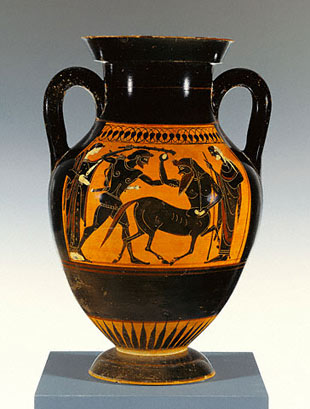
Greek culture could be clearly seen in Etruscan pottery, which mimicked the
Greek style. The shape, the colors, and even the artwork was so similar to
Greek that, if I hadn't known they were Etruscan, I would have mistaken them
for a Greek pieces.
 |
| This is one of the Etruscan pieces of pottery. |
 |
| This is a Greek piece. Notice the same colors and design,. The artwork at the base of both vases is almost identical. Only the figures are slightly different. The Greeks preferred more athletic looking bodies where in the Etruscan version you can clearly see the figures are not in the best shape. |
The Etruscans came before the Romans. They were thought to have started around the early 7th century BC with Rome's founding being in 753 BC. So it is actually Roman culture that copied the Etrucans. The Romans adopted certain religious customs, like haruspicy, and had many Etruscan kings. But the Etruscan sculptures seem to hold the most influence in Roman art. Etruscan sculptures have details added to make them look more lifelike. This style, combined with the Greek style, is how the Romans became some of the greatest artists in history. Another aspect of Etruscan culture that may or may not have influenced the Romans is their use of wall paintings in tombs. They are very elaborate and show everything from dinner parties and hunting to mythology where gods were depicted or false doors were painted to lead the dead to the underworld. I thought this style of decor was very similar to the way the Romans would later decorate their own houses. Romans especially loved painting false windows or doorways that lead to garden scenes. Could it be possible that these tomb paintings meant for the rooms of the dead could inspire decoration in the rooms of the living?
 |
| This is an Etruscan statue head that reminded me of many Roman works of art. |
 |
| An Etruscan tomb. This scene seems to be representing a feast. |
 |
| This is a fresco found in the Villa of Mysteries in Pompeii. It seems a more advanced version of the wall paintings found in the tombs of the Etruscans. |
It's interesting to see how much of Roman culture was not just borrowed from the Etruscans but also from many other cultures and they combined it to form one of the greatest empires of all time.




Nice post, Rachel! I also thought it was nice to get out of the city for the day and visit a quieter town. Here you included a picture of a tomb found in the museum, which was really cool. I'm wondering what you thought about the different tombs we visited outside Tarquinia, because I thought those were fascinating.
ReplyDeleteI thought those were better than the ones in the museum because they were in their original places and there was a great variety of paintings.
DeleteI also really enjoyed the trip out to Tarquinia. It was really nice to get a different perspective of living in Italy, but still be near Rome. I also thought the connection with Greek styles was very interesting. Not just in their pottery but in other pieces of art as well. I find it really interesting the amount of Greek influence there is all throughout Rome and Italy!
ReplyDeleteGood Post Rachel! That was an interesting trip I thought as well. It was nice to get out of Rome and get a fell for what a smaller town in Italy feels like, rather than using just the city of Rome to determine all of them. I do have a question for you about the tombs that we visited; do you think that was a unique or weird that they had the statues on top of the tombs? Or do you think that both terms could apply.
ReplyDeleteI don't think it was weird for their time period. The Egyptians had a similar style so the in the ancient world this was fairly normal. What might be unique to Etruscan culture is the way they are laying as if at a dinner party but I don't know for sure. That would take more research.
DeleteHey Rachel. You did a great job at connecting Greek, Roman, and Etruscan cultures using the stuff at the museum. I wish that the signs had been in English so that I could have more information than what I could guess from the Italian texts. What do you think made the Greeks such a center of culture in the Mediterranean?
ReplyDeleteI feel like the Greeks were a very advanced culture with their philosophy and art which was pleasing to many people that the later civilizations wanted to become the next culture that was even more beautiful. Those are just my thoughts, I'm not sure if there is an explanation for that.
Delete