Monday, June 15, 2015

Blog Post 7: The Layers of the of Basilica St. Clemente

The only picture I have. This is the entrance to the Basilica.
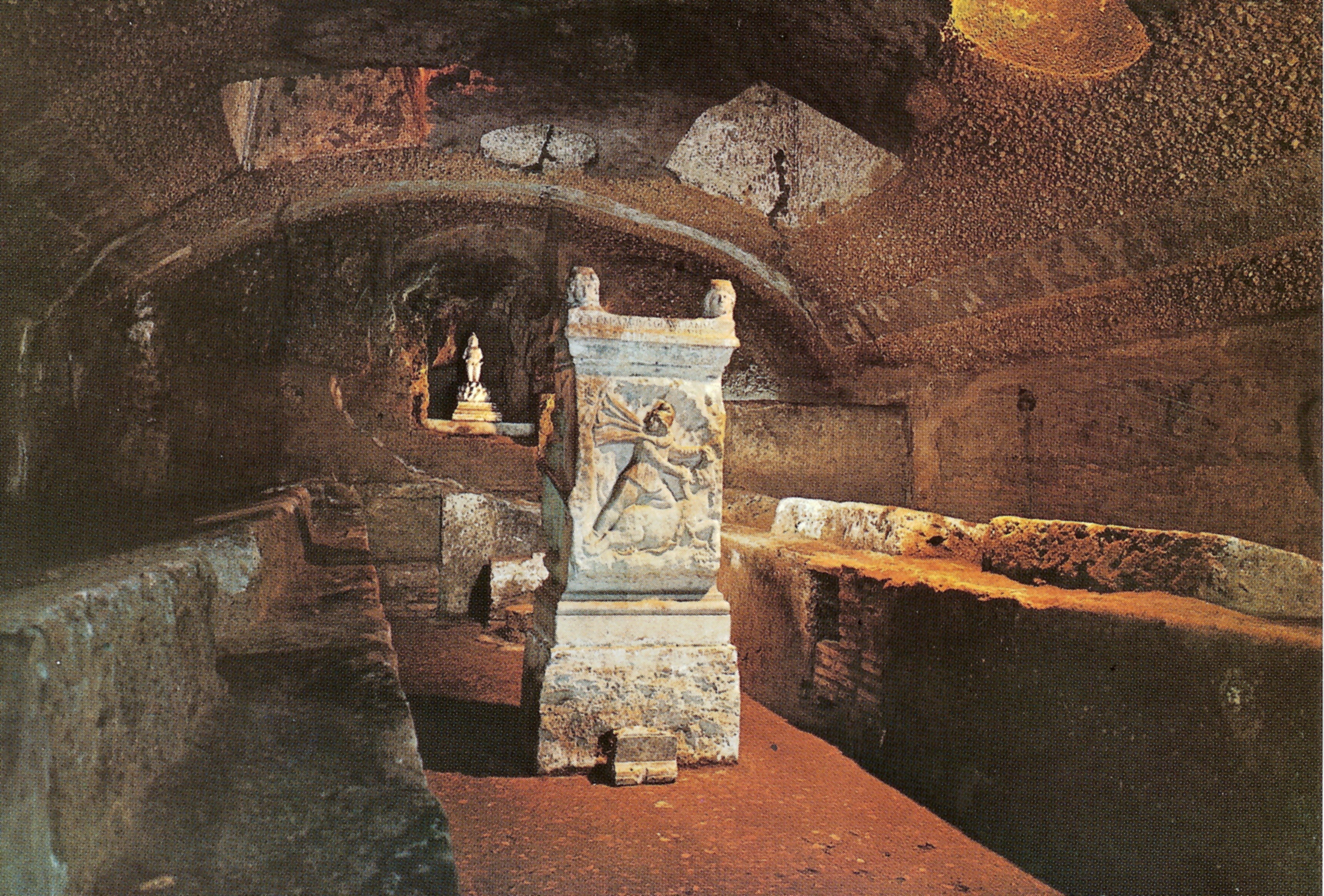
We are beginning to study the early Christians in Rome. Today we visited the Basilica of St. Clemente which is one of the churches in Rome assigned to a cardinal (and unfortunately they didn't allow pictures!)  but what is even more amazing about this church are the layers of its foundation. We had a guest professor visit us today and take us on a tour of all the layers of the Basilica. The first layer was around the first century AD and contained a private lodging and a public building with an alleyway between the two. In the private quarters there was a statue that represented the religion of mithraism. This form of religion is believed to have Persian origins. I thought it was interesting that not one, but two Catholic churches were over our heads as we looked at this shrine. I felt like it was a nice example of how the city and the culture changed over time.
Mithraism shrine.
Source: culturaltravelguide.com
The alley was very interesting to see. Back home, I am used to alleys that can hold a car plus a small group of people walking. In Rome, alleys seem to be a lot smaller but they are still big enough to fit a car through and people to walk in a single file line. This ancient alley, though, was so tiny I was questioning whether I could walk down it normally or if I would have to walk down it sideways. I thought there was no way people actually walked in between these buildings but when I turned to look at the other side, there were stairs built up the hill to make it easier to walk. People actually used this tiny alley! Seeing how close the buildings were, it's no wonder why fires were such a problem in ancient times.

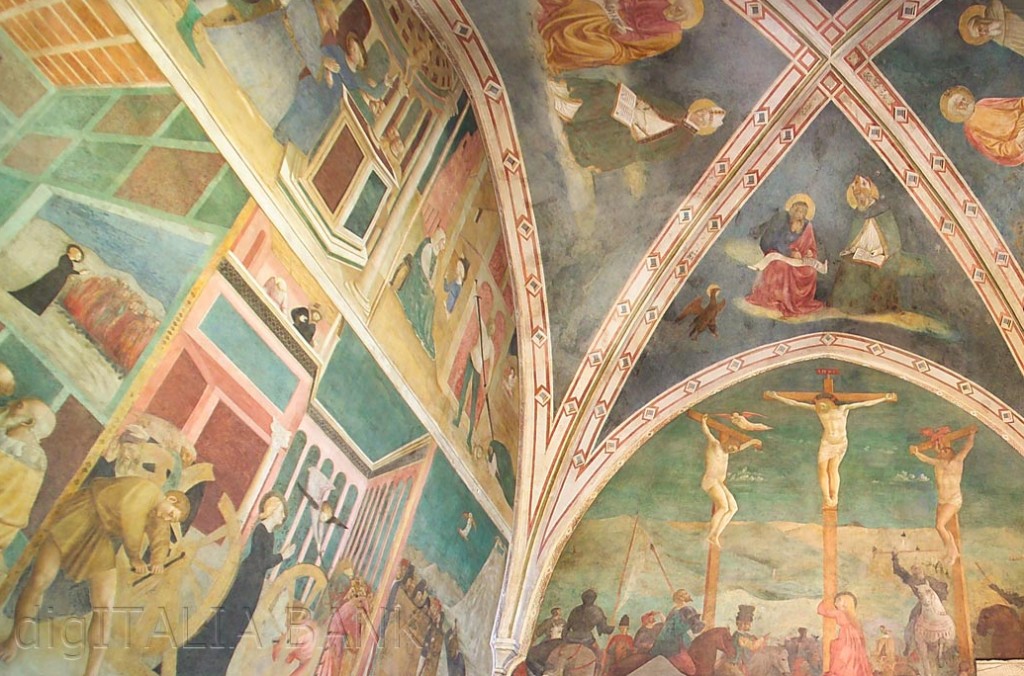
We then went up into the ruins of the early Basilica. It was decorated with beautiful frescoes that told the story of St. Clemente's burial and miracles that had happened in his name. There was also a fresco of St. Alexius of Rome. What I found interesting were the patrons, the families that paid for the frescoes to be painted, also painted into the frescoes or very near it. Although I believe it is a good thing to donate to your church if you truly believe in the faith and want to spread the word of God but it also upsets me how they did this back in the days of this church. The people put their families on display for everyone to see how important and devote they are. But the teachings of Jesus, the leader of their faith, speak of being humble. This, in my opinion, is the opposite of being humble which begs the question: how good were these families with regards to their faith?

The present day church was very different from the other churches I've seen here. It appeared smaller for one, but it had a huge alter that took up a lot of space, limiting the walking room. It also seemed lighter than the others we visited. Even in the Basilica Santa Maria degli Angeli e dei Martiri, which was a very bright church, the alter was dark. This entire church seemed full of light. It appeared older than the others, too. That could be because of the paintings didn't seem lifelike. Even though they were more three dimensional than those in the ruins of the church underneath,  they were still very flat compared to the other churches we've seen.

If I had to choose a favorite level of the church it would definitely be the bottom with the ancient Roman buildings. I do think church history is important and very interesting, but so few "every day" buildings exist in Rome and the alleyway provides a new perspective on how the Romans lived.
Basilica Santa Maria degli Angeli e dei Martiri, the paintings look lifelike and three dimensional .
These paintings are good in my opinion but it's easy to see the difference in the style of art used.
Source: exurbe.com

Thursday, June 11, 2015

Blog 5: Trajan's Forum

Colored reconstruction of the base of the Column of Trajan.
Today we were off to the last of the imperial fora: the Forum of Trajan. The this forum is massive and, I believe, one of the most impressive. The exedra (the semi circular side of the forum) are massive and many pillars are visible from the basilica. My favorite feature, though, is the column of Trajan. It was the first of its design of a facade going all the way up the column. In Trajan's time, it would have been painted bright colors and the paint would have made it easier to depict the scenes. It would have also had metal spears coming out of the marble for an even more 3-D effect. There was a Latin library on one side of the column and a Greek library on the other and these libraries would of had balconies someone could walk out on and see the higher portions of the column.
The right exedra and markets.

The column depicts the Dacian wars Trajan lead and won. It not only depicts the battles but also the work that had to be done in Dacia, modern day Romania, after it was captured. Soldiers are seen building and bring order and peace to the region they just concurred. Because it is between two libraries, it is believed to be based on a written scroll and for the column the words were replaced with pictures and the "scroll" was unraveled up the column.

This seems like the correct theory for the column but my first thoughts when I saw it was that the Romans were possibly trying to do their own version of the Egyptian obelisk. The Romans were always trying to do better than the previous empires, like the Etruscans and Greeks, so this might have been there way of doing better than the Egyptians. An obelisk had hieroglyphics on it that depicted some sort of literature, just like the column depicted the story of the Dacian conquests. But when I read about the scroll theory, it seemed more plausible. We also visited what remains of the Stadium of Domitian today which is now the Piazza Navona and an obelisk is in the center of it. It's not an Egyptian one, though, it's one the Romans carved out using hieroglyphics in the Latin language. Essentially, it's like someone using the Chinese alphabet to spell something in English when they don't really know the alphabet. So it is clear if the Romans wanted to make an obelisk they would try to make them look more like the originals.
The Roman obelisk.
You can see the sides don't have facades carved
in them, so it's not like the Column of Trajan.
Column of Trajan

Monday, June 8, 2015

Blog 4: Ostia, The Poor Man's Pompeii

Street with shops
We headed out to Ostia today. This used to be a port city that provided wheat and many other goods to the city of Rome. Because this was a working class city, the homes were not as lavish as those in places like Pompeii. As Rome began to decline, so did the need for Ostia and eventually it's landscape became swampy marsh land that was not inhabitable so the city was abandoned. When it was excavated, many buildings were very well preserved and it was comparable to the preservation of the town of Pompeii. Because Ostia was a port, though, and not an aristocrat's hangout, it showed how more common people lived, hence the title of this blog.

Ostia has many shops, apartments, and other various buildings preserved through time that give us an idea of what life was like. My personal favorite was the theater which looks to be based off of a Greek amphitheater. It was built by Agrippa during Augustus's reign. In front of the theater was a temple to an unknown god/goddess. Along the temple are well preserved offices of merchants and traders that were able to be identified because the Romans depicted what the person's office was by the mosaics on the floors. There were also shops that lined the the street behind the theater, showing that there was a lot of growth in Ostia and it had a thriving economy. The Bathes of Neptune are also found there, with the Neptune mosaic almost entirely intact. Another bath complex can be found, along with the forum, a temple to Jupiter, grain storage houses, mills, and the fire house that once held over three hundred men. This shows that not only was Ostia a large city, but the evidence of tools found there demonstrates their ability to handle the large population and trade.
Theater in Ostia. From this view, looking beyond the pillars and trees are where the merchants' offices are located. 
Neptune mosaic from the Bathes of Neptune. He is riding a chariot in this scene.

Ostia also has evidence of early Christianity. A sarcophagus was placed in the city as a shrine to a saint along with some questionable evidence where there were christen looking fish or other pictures in houses. This is to be expected because, as a port city, there is a melting pot of cultures and religions coming and going. In the beginnings of Christianity, it was preached that this was the religion for anyone, rich and poor. Ostia residence were not the wealthy aristocrats of Rome, so it's not surprising some of them adopted this new religion.
This is the sarcophagus shine in the city. There is a depiction of a man with a lamb on it which could be a christian symbol or it could be a symbol of one of the Roman gods. No one is sure today.

Ostia was a very interesting place because it shows more about daily Roman life than Rome itself does. It also shows common life and we are able to study the differences of the rich and the working class. This city was what kept Rome going and that allowed Rome to become the greatest empire of its time.

Blog 3: The Palatine Hill

Augustus' palace and Temple to Apollo 
Yesterday we saw the emperors' palaces on the Palatine Hill. Augustus was the first to live there, possibly to be near the hut of Romulus, connecting him to the founder of Rome. His palace was quite modest compared to the later emperors', which had to have additional structures built along the hill to support the growth of the palaces. There were also temples on the hill. Augustus even had the senate meet on the peak instead of at the Senate House because, rumor has it, he didn't want to walk down the hill. Stories like that make Augustus seems more like a normal person than this great emperor. It reminds us that no matter how important a person is, no matter how great their legacy is, they still get tired of walking up and down hills, just like everyone else. Domitian, Trajan, Hadrian, Nero, Caligula, and many other emperors continued the tradition of living there. After Constantine, though, the emperors started to move around and the capitol was wherever the emperor was, not Rome.
Hut village where Romulus' hut is supposedly 

I thought the Palatine Hill was comparable to the history of Rome. It started out with the hut of Romulus, a small, humble beginning. Then, as Rome became larger and richer, aristocrats moved there. This happened during the Republic era. Aristocrats were in charge of the senate at this time, like they were dominating the hill. Then, Augustus chose the hill for his palace. It was modest housing, just as his rule was modest, providing peace for Rome and giving to the common people. After that, the palaces grew and grew, each emperor trying to outdo the others, just like with their building projects and conquests. Then, during the decline, the hill was almost forgotten and the emperors moved away like they did from Rome. It seems fitting the hill has the same history as the empire.

Gardens from Augustus' Palace


Sunday, June 7, 2015

Journal Post 4: Early Rising Means Short Lines

Photos: Adam Yeske (Vatican)
This morning Adam and I went to mass. Walking into the Vatican for the first time was like nothing I had ever experienced. This church held so much history of my faith that I was over whelmed and had to fight back tears. I couldn't believe I was in this church. We walked down the aisle of the basilica and noticed at the various alters masses were being held. At the farthest point, just a little before the alter of St. Peter we saw there was a mass being held in English, so we joined that one. It was strange, there weren't any pews and people just gathered around the alter where the priest was saying mass. It was a beautiful service and we even got a picture with the priest! Right after that, a mass started in the main portion of the basilica and as we were creeping to get a closer look, we stumbled upon the basement where there were the tombs of the popes and some other saints. We went down and looked around and I was able to see the tomb of St. Peter. That lead outside so we went back around to go back in but when we tried again to have a closer look at the main mass the security stopped us and said we couldn't enter. It wasn't just us, it was everybody. We had gone at the right time when most of the church was open. We looked at a few more alters before leaving. I can't wait to go back! As we were walking out of the square, we saw that the line to enter the church, which had only been about twenty people when we went in, was at least a quarter of a mile long! In the hour and a half that we had been there, the line had grown that much?! Good thing we got up early!

Later that day, we visited the Capitoline Hill which used to house the imperial palace. It was interesting to think that the few pieces of flooring that were left were walked on by the emperors. It was an exciting moment to be standing in their doorway.

The last part of the day almost rivaled the Vatican. We finally were able to see the inside of the Colosseum! The archways and the views were so spectacular I stopped taking pictures after awhile because they just couldn't capture the beauty of the structure. I stood on the second level just imagining what the games were like. Thinking about all those who had died there. When we were walking through the lower arch ways, it was hard not to imagine how the gladiators must have felt walking through these arches, wondering if they would make it out alive. By the time we left, we had spent almost an hour and a half there and I could have easily spent the entire evening there. It was a spectacular sight.

Photos: Jonah Poppen (Colosseum


Saturday, June 6, 2015

Journal Post 3: Seeing the Discobolus and my first mummy!

Note: I decided to post my journal entries on this blog for those of you who are following it in the US. I'll type up my other journal entries as soon as possible.

Via Labicana Augustus
This morning we visited the National Roman Museum at Palazzo Massimo. Aaron pointed out the Via Labicana Augustus and talked about how this particular statue showed Augustus as a person of faith that would win over the common people. It is also my favorite statue of Augustus and the fact that I was 5 feet away from it was incredible. This particular version of him I feel shows a humble side to him. It makes him more human to me rather than this emperor of Rome that was so great he almost seems unreal. This statue shows how human he was but still retains an impressive likeness of him.

This museum held many other works of art that I loved. There was a Portrait of Caracalla and I was so happy because the one that is usually shown at the Centrale Montemartini was put away the day we went (which was yesterday). Even though Caracalla wasn't the best emperor, far from it actually, I love his portrait because of the way his forehead and eyebrows are always depicted. There were many wall paintings, too, most notably the garden scene from the Villa of Livia. This one is so detailed and beautiful; it was my favorite. When I was looking at all the villa paintings there was a sense of awe that they couldn't be real. I have studied the different styles of wall paintings the Romans had done and seeing these in person gave me the feeling I studied these things for a purpose and I felt more connected to the artwork I was observing.
Caracalla
Villa of Livia
Discobolus
There were many other sculptures that were impressive or silly but the one that I was most excited to see was the Discobolus. I absolutely love this statue and seeing it today flooded me with the feeling that all that I had read and learned lead to that moment. That sound incredibly cheesy but seeing this sculpture has been the highlight of this trip so far.

There was one final floor that I hadn't seen. I went down there with only ten minuets left because I had spent most of the time looking at the Discobolus or Augustus. The last floor has a lot of coins and pottery. These were interesting but I didn't have time to stop and read a lot of what was going on in that period of history. I finally made it to the final room where there was a lot of jewelry on display. At that point I only had three minuets left so I was semi rushing through the jewels. I made it to the back of the room when I turned to see the last of the jewels and instead of jewels there is a mummified girl behind me. Of course I was shocked, and I possibly gave out a terrified gasp when I saw her, but after that passed I couldn't believe I was looking at a mummy! It was an eight year old girl that was more than likely an aristocratic. I've never seen a mummy so I was fascinated and slightly terrified when I was looking at her. I didn't come to Rome expecting to see a mummy but it's amazing that I did!

Thursday, June 4, 2015

Blog 2: Etruscan Influence

Yesterday we escaped the noise and bustle of Rome and traveled about an hour to the hillside town of Tarquinia. Being a small town girl, I loved it even more than Rome. We saw the Museo Nazionale Tarquiniense, which had many Etruscan artifacts, including many sarcophagi. We also visited the Necropolis and saw different tombs of the Etruscans. Etruscan art seemed reminiscent of other ancient civilizations (i.e. Greece, Egypt, and, of course, Rome).

The sarcophagi were mostly all topped with a figure of the deceased reclining as if they were at a dinner party. One was less damaged by time than the rest, with paint still visible on it. This one had the figure lying down, similar to the sarcophagi that were found in ancient Egypt, though not made out of gold. This sarcophagus was more preserved because the stone that was used was of higher quality than the others that had all but eroded away. Whoever had been buried in it was wealthy and of a far greater status in society.
This is the sarcophagus with the paint still preserved and with the figure lying down. The stone is very well preserved.


This is one of the sarcophagi that was not as high of quality as the one above. Notice how much erosion is on the face compared to the previous one, which is almost in perfect shape.


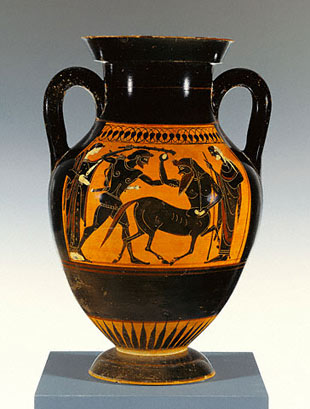
The connection to Greek culture could be clearly seen in Etruscan pottery, which mimicked the Greek style. The shape, the colors, and even the artwork was so similar to Greek that, if I hadn't known they were Etruscan, I would have mistaken them for a Greek pieces.
This is one of the Etruscan pieces of pottery. 
This is a Greek piece. Notice the same colors and design,. The artwork at the base of both vases is almost identical. Only the figures are slightly different. The Greeks preferred more athletic looking bodies where in the Etruscan version you can clearly see the figures are not in the best shape. 


The Etruscans came before the Romans. They were thought to have started around the early 7th century BC with Rome's founding being in 753 BC. So it is actually Roman culture that copied the Etrucans. The Romans adopted certain religious customs, like haruspicy, and had many Etruscan kings. But the Etruscan sculptures seem to hold the most influence in Roman art. Etruscan sculptures have details added to make them look more lifelike. This style, combined with the Greek style, is how the Romans became some of the greatest artists in history. Another aspect of Etruscan culture that may or may not have influenced the Romans is their use of wall paintings in tombs. They are very elaborate and show everything from dinner parties and hunting to mythology where gods were depicted or false doors were painted to lead the dead to the underworld. I thought this style of decor was very similar to the way the Romans would later decorate their own houses. Romans especially loved painting false windows or doorways that lead to garden scenes. Could it be possible that these tomb paintings meant for the rooms of the dead could inspire decoration in the rooms of the living?
This is an Etruscan statue head that reminded me of many Roman works of art.
An Etruscan tomb. This scene seems to be representing a feast.
This is a fresco found in the Villa of Mysteries in Pompeii. It seems a more advanced version of the wall paintings found in the tombs of the Etruscans. 


It's interesting to see how much of Roman culture was not just borrowed from the Etruscans but also from many other cultures and they combined it to form one of the greatest empires of all time. 

Wednesday, June 3, 2015

Blog 1: The Circus Maximus

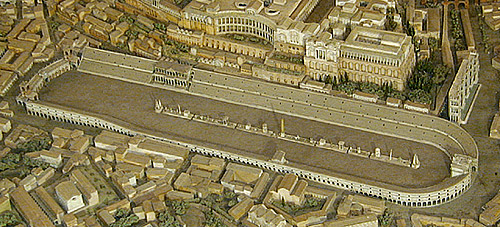
This is the ancient layout of the Circus Maximus. It was 2000x500 ft.
So I finally make it to Rome and we start off with one of the coolest race tracks of all time, the Circus Maximus. When we arrived at the ruins though, I didn’t even know I was standing on top of it. I had seen pictures of what it probably looked like, a massive race track that could seat 250,000 people. I wasn’t expecting what was there, which was almost nothing. The side we entered on I saw a larger sand, rock area with joggers running toward the other end. I was shocked that this was the site of such a massive structure. Looking back at it now, I’m really happy that all I had was a description of what it used to be because than I have the shock of seeing what it looks like today. Later that day we walked past the Coliseum and although it was impressive and I couldn’t stop staring, I didn’t have that shock of seeing what it actually looked like because I have seen pictures of it as it is now. Although I would have like to see more ruins of it, I thought what was left was very beautiful and I was so happy to be standing on the foundations of one of the greatest structures ever built. What made me incredibly happy, though, was watching runners and bikers following the rocky path. It reminded me of a track in a way and even though the people were not racing, it felt like this place was still being used for its original purposes which were sports and entertainment. There were people there who were also playing catch, a source of entertainment and with the runners and bikers, people practicing their sports. As for an audience that would have filled the grand stands, there weren’t quite 250,000 people but there were many on the outskirts of the grounds, where the stands would have been, watching everyday life and just relaxing. In a way, the core of what the Circus Maximus was intended for can still be seen but then the question is whether people understand exactly what the ground they are standing on represents. People may not see it as I did and just see it as a very large park. In that case, the significance diminishes and that is a sad thought.  
This is what the Circus Maximus looks like in 2015. If you look closely on the right you can see two dots; those are runners.
This is the way the Colosseum looks today. It looks similar to all the other pictures I've seen of it so the shock of seeing it wasn't as great.

These are some of the few ruins that are located at the Circus Maximus. They are of the concrete grandstands.

Monday, June 1, 2015

Journal Post 1: Finally Here!


Old Elevator


I'm finally in Rome! Getting off the plane and stepping on Italian ground was surreal! On the flight over I saw the sea and mountains for the first time. They were so beautiful and it was a weird feeling looking at the mountains. I hadn't realized until that moment when I was looking at them that I had never seen mountains before. The pictures don't do them justice.I also didn't realize how tall they were until some of the clouds cleared. I'm excited to see them again when we go back.

The city is so huge and cramped! I think it's a cool layout, streets placed sporadically about. People drive crazy here! And people call me a bad driver, they need to come here!

We walked around for a bit and found the grocery store, pharmacy, and the gelato shop.That last one is the most important. :)  We picked some up before going back to the apartment, it's so good!  

Our apartment is really cool. It has an old fashion elevator and the building we live in is "new" for the city. It's still at least eighty years old still. I am so excited for the days to come. Just being here now makes me so happy and I haven't even seen anything yet!
View from outside my window.