Wednesday, August 19, 2015

Journal 7: Rome After Two Weeks

I love Rome. I love the food, the layout, the history, the art, everything. Yet, I don't think I would want to live here. I'm am so tired. Today we visited the Pantheon and even though it was amazing, I just didn't feel like I had the energy to appreciate it fully. When I went to the Vatican a week ago, there weren't many people around yet because it was so early in the morning. It was peaceful and I felt like I was able to take all the sights in. When we went to the Colosseum, it was so large that it was easy to walk around and find your little corner of it and just admire the structure. But today, although the Pantheon is quite large, there were hundreds of people trying to see everything that I was trying to see. I can't blame them of course because I'm just as much of an annoying tourist as they are but the fast pace that I was looking at it was upsetting now that I look back at it. And I feel like that is the way it is with a lot of the places we have been visiting. I could spend hours in some of the museums we go to but unfortunately we have to fit so much history into three weeks that there is a time limit on everything. This rushing to see absolutely everything is a big contributor to my exhaustion.

I don't want to leave though. True, I'm definitely not cut out for the city and I miss the country side and houses (honestly, I don't think I've seen one house in Rome) but this city is my favorite by a long shot. It doesn't have the tall buildings made of metal and glass. It has history, and stone. Instead of tearing down old buildings, they restore the old ones and remodel them to fit the desired need. Yesterday we visited Trajan's markets and the museum was held in the ruins of the markets!
This is one of the streets we walk through to get
to the accent center. Yes, cars drive here.
It doesn't have the the concrete sidewalks or the grid-like streets. It twists and turns and some how I make it to where I need to be without actually knowing how I got there. It's fun to see how people can just walk on the cobble stones and cars just come along. Yes, they honk at you and their driving is even worse than those in North Dakota, but I love the interaction.

Blog Post 8: Musei Vaticani

Sistine Chapel
Today was the Vatican Museum. Aaron showed us the way to the Sistine Chapel and then we were on our own. There were so many people at the museum that I quickly lost everyone in my group. I walked through halls of canvasses meant to cover the workers that were doing restorations. It seemed like half the museum was either closed or being restored! I walked through halls with tapestries, paintings, and many other objects that seemed like a blur. I didn't stay long in one room because of all the people. I vaguely remember practically running through the modern art exhibit (that's how much I adore modern art). I finally made it to the chapel. Everything will be alright now I thought, but walking in I was overwhelmed even more. There were so many people and so much going on with the walls my head was spinning! To make matters worst, there were guards everywhere yelling at us to be quite (just a tiny bit counter productive) and telling us pictures were forbidden. I saw one guard run over to a man to inspect the object in his hand, thinking it might be a camera. I stared at the walls and ceiling not really looking at any of it. I always saw pictures of the chapel and thought it would be so wonderful to go and see but when I finally got there, the only thing I wanted to see was an exit. There were so many people I was being nudged about to really concentrate on any of the paintings. This has been the only time on this trip where I would have proffered the pictures to the real thing. Blasphemy, I know, but it's the truth. The walls were painted for those who went to the chapel to look at and reflect on. I stared at the last judgment, picking out pieces that I had studied in my Catholic courses but nothing struck me as "awe inspiring" or "life changing". It was a picture and there were still too many people hitting up against my sides and back. I think the chapel should be revered for its wonderful artwork and I'm sure many who visit the chapel do feel something when looking at the paintings. I just didn't.

St. Jerome in the Wilderness by da Vinci
Source: https://en.wikipedia.org/wiki/Vatican_Museums#
/media/File:Leonardo,_san_girolamo.jpg
After escaping the chapel. I wondered around a bit. I walked through the Egyptian exhibit about three times and the hall of Roman busts twice. About half the pieces had labels. I saw Laocoön and His Sons, an Etruscan gold fibula, and even the Prima Porta from a distance since the section was closed off. After a lot of wondering I found a section that had many religious paintings of saints, Jesus, and Mary. Many of the artists were from the Renaissance period and the attention to detail was incredible. I particularly liked Leonardo da Vinci's St. Jerome in Wilderness. I was surprised by how many paintings of St. Jerome there were. I didn't know much about St. Jerome, his name was the extent of my knowledge and it made me curious why this man was featured so much. After reading a little about him, I found out that Jerome spent a lot of time in Rome writing translations. He is now considered one of the Latin doctors of the Catholic Church. He spent a fair amount of his life as a hermit in the Syrian desert, which explains why he is depicted in the wilderness.

Monday, June 15, 2015

Blog Post 7: The Layers of the of Basilica St. Clemente

The only picture I have. This is the entrance to the Basilica.
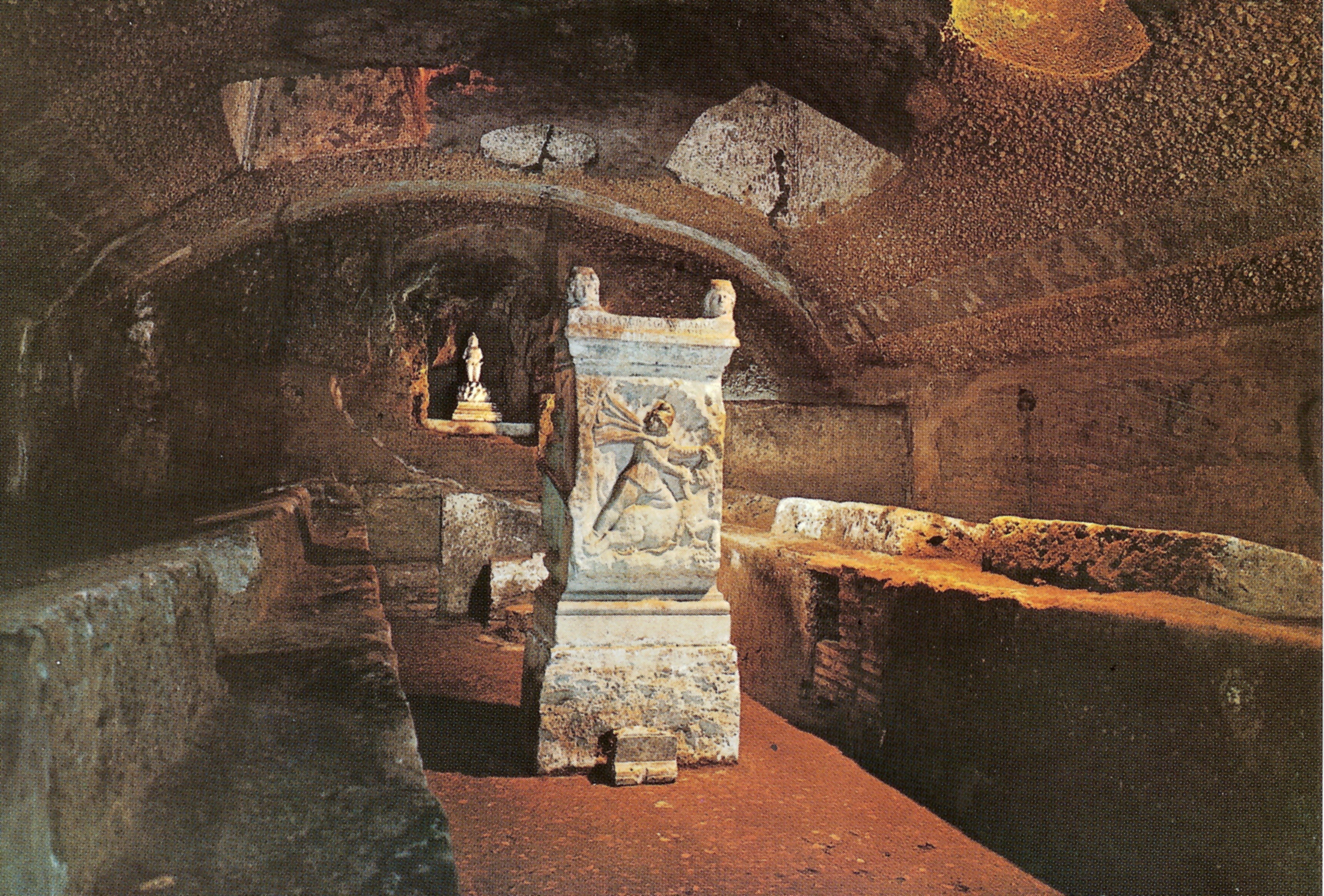
We are beginning to study the early Christians in Rome. Today we visited the Basilica of St. Clemente which is one of the churches in Rome assigned to a cardinal (and unfortunately they didn't allow pictures!)  but what is even more amazing about this church are the layers of its foundation. We had a guest professor visit us today and take us on a tour of all the layers of the Basilica. The first layer was around the first century AD and contained a private lodging and a public building with an alleyway between the two. In the private quarters there was a statue that represented the religion of mithraism. This form of religion is believed to have Persian origins. I thought it was interesting that not one, but two Catholic churches were over our heads as we looked at this shrine. I felt like it was a nice example of how the city and the culture changed over time.
Mithraism shrine.
Source: culturaltravelguide.com
The alley was very interesting to see. Back home, I am used to alleys that can hold a car plus a small group of people walking. In Rome, alleys seem to be a lot smaller but they are still big enough to fit a car through and people to walk in a single file line. This ancient alley, though, was so tiny I was questioning whether I could walk down it normally or if I would have to walk down it sideways. I thought there was no way people actually walked in between these buildings but when I turned to look at the other side, there were stairs built up the hill to make it easier to walk. People actually used this tiny alley! Seeing how close the buildings were, it's no wonder why fires were such a problem in ancient times.

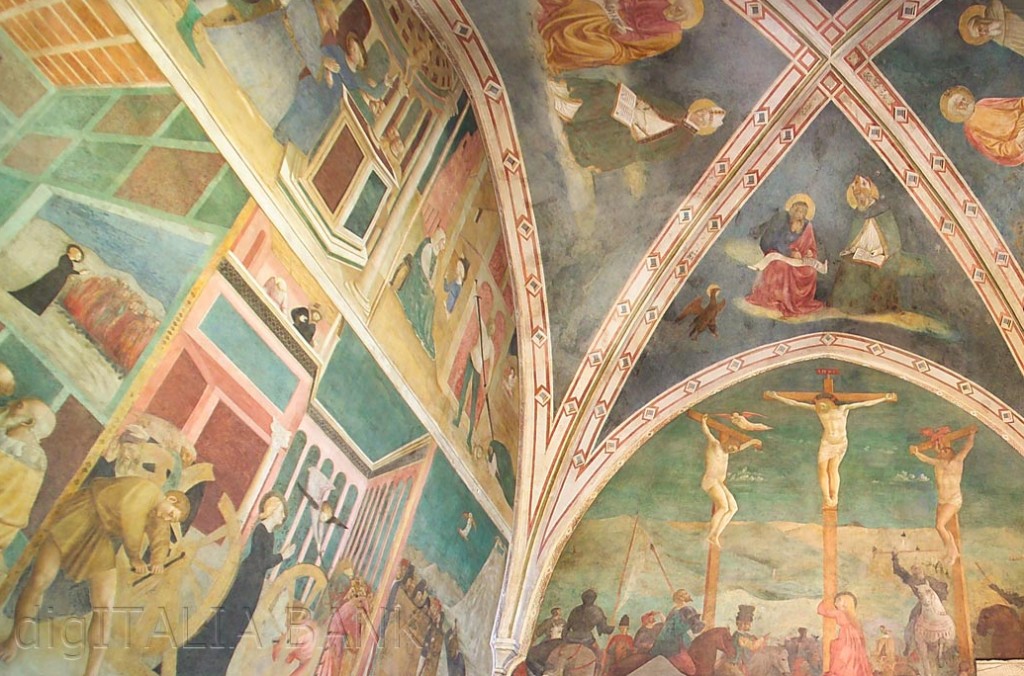
We then went up into the ruins of the early Basilica. It was decorated with beautiful frescoes that told the story of St. Clemente's burial and miracles that had happened in his name. There was also a fresco of St. Alexius of Rome. What I found interesting were the patrons, the families that paid for the frescoes to be painted, also painted into the frescoes or very near it. Although I believe it is a good thing to donate to your church if you truly believe in the faith and want to spread the word of God but it also upsets me how they did this back in the days of this church. The people put their families on display for everyone to see how important and devote they are. But the teachings of Jesus, the leader of their faith, speak of being humble. This, in my opinion, is the opposite of being humble which begs the question: how good were these families with regards to their faith?

The present day church was very different from the other churches I've seen here. It appeared smaller for one, but it had a huge alter that took up a lot of space, limiting the walking room. It also seemed lighter than the others we visited. Even in the Basilica Santa Maria degli Angeli e dei Martiri, which was a very bright church, the alter was dark. This entire church seemed full of light. It appeared older than the others, too. That could be because of the paintings didn't seem lifelike. Even though they were more three dimensional than those in the ruins of the church underneath,  they were still very flat compared to the other churches we've seen.

If I had to choose a favorite level of the church it would definitely be the bottom with the ancient Roman buildings. I do think church history is important and very interesting, but so few "every day" buildings exist in Rome and the alleyway provides a new perspective on how the Romans lived.
Basilica Santa Maria degli Angeli e dei Martiri, the paintings look lifelike and three dimensional .
These paintings are good in my opinion but it's easy to see the difference in the style of art used.
Source: exurbe.com

Thursday, June 11, 2015

Blog 5: Trajan's Forum

Colored reconstruction of the base of the Column of Trajan.
Today we were off to the last of the imperial fora: the Forum of Trajan. The this forum is massive and, I believe, one of the most impressive. The exedra (the semi circular side of the forum) are massive and many pillars are visible from the basilica. My favorite feature, though, is the column of Trajan. It was the first of its design of a facade going all the way up the column. In Trajan's time, it would have been painted bright colors and the paint would have made it easier to depict the scenes. It would have also had metal spears coming out of the marble for an even more 3-D effect. There was a Latin library on one side of the column and a Greek library on the other and these libraries would of had balconies someone could walk out on and see the higher portions of the column.
The right exedra and markets.

The column depicts the Dacian wars Trajan lead and won. It not only depicts the battles but also the work that had to be done in Dacia, modern day Romania, after it was captured. Soldiers are seen building and bring order and peace to the region they just concurred. Because it is between two libraries, it is believed to be based on a written scroll and for the column the words were replaced with pictures and the "scroll" was unraveled up the column.

This seems like the correct theory for the column but my first thoughts when I saw it was that the Romans were possibly trying to do their own version of the Egyptian obelisk. The Romans were always trying to do better than the previous empires, like the Etruscans and Greeks, so this might have been there way of doing better than the Egyptians. An obelisk had hieroglyphics on it that depicted some sort of literature, just like the column depicted the story of the Dacian conquests. But when I read about the scroll theory, it seemed more plausible. We also visited what remains of the Stadium of Domitian today which is now the Piazza Navona and an obelisk is in the center of it. It's not an Egyptian one, though, it's one the Romans carved out using hieroglyphics in the Latin language. Essentially, it's like someone using the Chinese alphabet to spell something in English when they don't really know the alphabet. So it is clear if the Romans wanted to make an obelisk they would try to make them look more like the originals.
The Roman obelisk.
You can see the sides don't have facades carved
in them, so it's not like the Column of Trajan.
Column of Trajan

Monday, June 8, 2015

Blog 4: Ostia, The Poor Man's Pompeii

Street with shops
We headed out to Ostia today. This used to be a port city that provided wheat and many other goods to the city of Rome. Because this was a working class city, the homes were not as lavish as those in places like Pompeii. As Rome began to decline, so did the need for Ostia and eventually it's landscape became swampy marsh land that was not inhabitable so the city was abandoned. When it was excavated, many buildings were very well preserved and it was comparable to the preservation of the town of Pompeii. Because Ostia was a port, though, and not an aristocrat's hangout, it showed how more common people lived, hence the title of this blog.

Ostia has many shops, apartments, and other various buildings preserved through time that give us an idea of what life was like. My personal favorite was the theater which looks to be based off of a Greek amphitheater. It was built by Agrippa during Augustus's reign. In front of the theater was a temple to an unknown god/goddess. Along the temple are well preserved offices of merchants and traders that were able to be identified because the Romans depicted what the person's office was by the mosaics on the floors. There were also shops that lined the the street behind the theater, showing that there was a lot of growth in Ostia and it had a thriving economy. The Bathes of Neptune are also found there, with the Neptune mosaic almost entirely intact. Another bath complex can be found, along with the forum, a temple to Jupiter, grain storage houses, mills, and the fire house that once held over three hundred men. This shows that not only was Ostia a large city, but the evidence of tools found there demonstrates their ability to handle the large population and trade.
Theater in Ostia. From this view, looking beyond the pillars and trees are where the merchants' offices are located. 
Neptune mosaic from the Bathes of Neptune. He is riding a chariot in this scene.

Ostia also has evidence of early Christianity. A sarcophagus was placed in the city as a shrine to a saint along with some questionable evidence where there were christen looking fish or other pictures in houses. This is to be expected because, as a port city, there is a melting pot of cultures and religions coming and going. In the beginnings of Christianity, it was preached that this was the religion for anyone, rich and poor. Ostia residence were not the wealthy aristocrats of Rome, so it's not surprising some of them adopted this new religion.
This is the sarcophagus shine in the city. There is a depiction of a man with a lamb on it which could be a christian symbol or it could be a symbol of one of the Roman gods. No one is sure today.

Ostia was a very interesting place because it shows more about daily Roman life than Rome itself does. It also shows common life and we are able to study the differences of the rich and the working class. This city was what kept Rome going and that allowed Rome to become the greatest empire of its time.

Blog 3: The Palatine Hill

Augustus' palace and Temple to Apollo 
Yesterday we saw the emperors' palaces on the Palatine Hill. Augustus was the first to live there, possibly to be near the hut of Romulus, connecting him to the founder of Rome. His palace was quite modest compared to the later emperors', which had to have additional structures built along the hill to support the growth of the palaces. There were also temples on the hill. Augustus even had the senate meet on the peak instead of at the Senate House because, rumor has it, he didn't want to walk down the hill. Stories like that make Augustus seems more like a normal person than this great emperor. It reminds us that no matter how important a person is, no matter how great their legacy is, they still get tired of walking up and down hills, just like everyone else. Domitian, Trajan, Hadrian, Nero, Caligula, and many other emperors continued the tradition of living there. After Constantine, though, the emperors started to move around and the capitol was wherever the emperor was, not Rome.
Hut village where Romulus' hut is supposedly 

I thought the Palatine Hill was comparable to the history of Rome. It started out with the hut of Romulus, a small, humble beginning. Then, as Rome became larger and richer, aristocrats moved there. This happened during the Republic era. Aristocrats were in charge of the senate at this time, like they were dominating the hill. Then, Augustus chose the hill for his palace. It was modest housing, just as his rule was modest, providing peace for Rome and giving to the common people. After that, the palaces grew and grew, each emperor trying to outdo the others, just like with their building projects and conquests. Then, during the decline, the hill was almost forgotten and the emperors moved away like they did from Rome. It seems fitting the hill has the same history as the empire.

Gardens from Augustus' Palace


Sunday, June 7, 2015

Journal Post 4: Early Rising Means Short Lines

Photos: Adam Yeske (Vatican)
This morning Adam and I went to mass. Walking into the Vatican for the first time was like nothing I had ever experienced. This church held so much history of my faith that I was over whelmed and had to fight back tears. I couldn't believe I was in this church. We walked down the aisle of the basilica and noticed at the various alters masses were being held. At the farthest point, just a little before the alter of St. Peter we saw there was a mass being held in English, so we joined that one. It was strange, there weren't any pews and people just gathered around the alter where the priest was saying mass. It was a beautiful service and we even got a picture with the priest! Right after that, a mass started in the main portion of the basilica and as we were creeping to get a closer look, we stumbled upon the basement where there were the tombs of the popes and some other saints. We went down and looked around and I was able to see the tomb of St. Peter. That lead outside so we went back around to go back in but when we tried again to have a closer look at the main mass the security stopped us and said we couldn't enter. It wasn't just us, it was everybody. We had gone at the right time when most of the church was open. We looked at a few more alters before leaving. I can't wait to go back! As we were walking out of the square, we saw that the line to enter the church, which had only been about twenty people when we went in, was at least a quarter of a mile long! In the hour and a half that we had been there, the line had grown that much?! Good thing we got up early!

Later that day, we visited the Capitoline Hill which used to house the imperial palace. It was interesting to think that the few pieces of flooring that were left were walked on by the emperors. It was an exciting moment to be standing in their doorway.

The last part of the day almost rivaled the Vatican. We finally were able to see the inside of the Colosseum! The archways and the views were so spectacular I stopped taking pictures after awhile because they just couldn't capture the beauty of the structure. I stood on the second level just imagining what the games were like. Thinking about all those who had died there. When we were walking through the lower arch ways, it was hard not to imagine how the gladiators must have felt walking through these arches, wondering if they would make it out alive. By the time we left, we had spent almost an hour and a half there and I could have easily spent the entire evening there. It was a spectacular sight.

Photos: Jonah Poppen (Colosseum